AI IEP writer for special education teachers
The documentation the job requires. Not the hours it used to cost you.
A complete IEP draft in about ninety seconds: present levels, measurable goals, accommodations, services, and LRE, built around what IDEA requires and ready for your review before your meeting. Not a page of goal suggestions or sentence starters.
In the app, type a student's real name once and it's swapped for an alias in your browser before anything is sent; dates, IDs, and contact details are caught automatically. The free trial has no name field, so leave real names out of what you paste there.
Start a draft with no account. A free account, email only and no credit card, opens your complete first IEP draft.
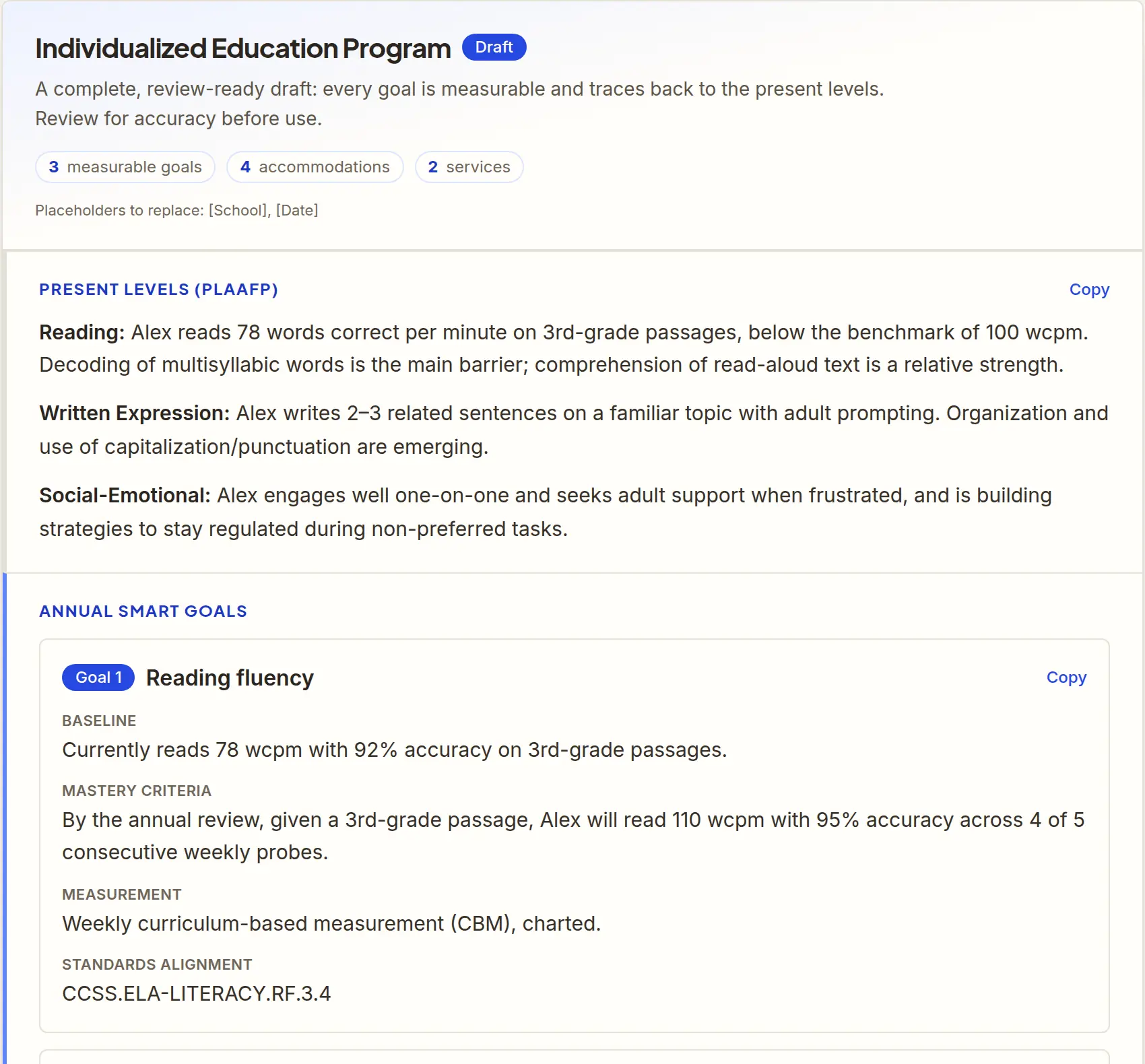
01 · The complete draft
The whole IEP, drafted in about ninety seconds.
Paste the evaluation, last year's IEP, or your meeting notes, and get the entire annual plan back: present levels, measurable goals, services, accommodations, LRE, and state testing, shaped to your state's rules. Goals cite your state's own standards where adopted (Common Core, TEKS, SOLs, and similar).
Then edit any section by hand, nudge the AI, and export to Word or PDF. You stay the expert; it does the typing.
How it works
- 1Add what you havePaste or upload the evaluation, the current IEP, or your meeting notes. Tell us the student's real name and it's swapped for a private alias in your browser before anything is sent; dates, IDs, emails, and phone numbers are caught automatically either way.
- 2Generate the draftA complete, state-shaped IEP in about ninety seconds: present levels, measurable goals, services, accommodations, LRE, and testing.
- 3Review, refine, exportEdit any section by hand or nudge the AI, run the review checklist, and export to Word or PDF. You stay the expert.
And every other document the year asks for:
02 · Not a canned goal bank
Goal 1 · Reading fluency
[Student] will read grade-level text at 100 words correct per minute across 4 of 5 weekly probes.
Ways to measure it, pick one
- Curriculum-based measurement, weekly
- Frequency count during a five-minute read-aloud
- Rubric-scored fluency check, biweekly
Goals built from your student, not copied from a list.
A canned goal bank hands you someone else's goal to bend until it fits. This works the other way: paste the needs and the data you have, and the goals come out already fitted, baseline and criterion in the same unit, measurable as written. (Want an actual starter list instead? We publish one: our free IEP goal bank.)
Each goal comes with two or three genuinely different ways to collect the data, because your para's setup isn't your co-teacher's. And if goals and accommodations are all you need today, skip present levels and services entirely.
Make a free account03 · For your gen-ed teachers
Any IEP, readable on one page.
Paste an IEP and get the one-pager your gen-ed teachers will actually read: who this student is, health information where nobody can miss it, and every accommodation rewritten as a plain instruction instead of compliance language.
Nothing gets invented. If the IEP doesn't say it, it shows up as a question for the case manager rather than advice on the page. Free, with no account; dates, IDs, and contact details are flagged in your browser before anything is sent, and a name you enter in the name box is swapped out there too.
Summarize an IEP freeOn the one page
- Who this student is. Strengths and needs in two sentences, not a case file.
- Health first. Conditions, plans, and where the procedures live, above everything else.
- Accommodations as instructions. "Read directions aloud" instead of a paragraph of legalese.
- Honest gaps. What the IEP doesn't say, listed as questions for the case manager.
04 · Progress monitoring, built in
Write the plan, then track it.
The meeting is where the year's work starts. For each goal, IEP Architect reads how it's measured and hands you the matching tool to collect data, instead of a generic number box or a separate spreadsheet.
Every point you log builds toward the next progress report, so it writes from real data instead of memory.
See a real progress report →A tool for every goal
- Trial tracker. Tap correct or incorrect and the percentage adds up for you.
- Frequency counter. One tap each time a behavior happens.
- Duration timer. Start and stop to time attention or a behavior.
- Rubric score. Score a writing sample against its rubric total.
05 · Free for every teacher
Useful before you ever pay us a dollar.
In-browser tools that build exactly the sheet your caseload needs: data sheets with your columns, visual schedules, progress graphs with the aimline drawn, a one-pager for whoever covers your room. Plus 22 ready-to-print PDFs in this library, every one previewable and none behind an email. No account, and nothing you type leaves your browser.
Try the free tools →The whole year, closed
One system for the whole loop.
Special education runs in a circle, and everything above covers a step of it, from the evaluation that opens a file to the triennial that closes the loop and starts it again.
- 1
Evaluate
Build your portion one write-up at a time, tests and observations both, then draft needs and supports from the whole file.
- 2
Write the IEP
The full annual plan: present levels, goals, services, accommodations, LRE.
- 3
Track progress
Log data on each goal; progress reports write themselves from it.
- 4
Plan ESY
When regression is a risk, draft the summer plan from the goals most at risk.
- 5
Re-evaluate
The triennial comes around, and the loop starts again with last year already in hand.
Every stage carries the last one forward: the evaluation feeds the IEP, the IEP feeds progress, and the year loops back with the record already built.
Privacy is the architecture
Built so student data never has to leave the room.
- No names, birthdates, or student IDs stored. Only educational characteristics, the things a goal is built from, plus the alias you choose.
- Redaction happens in your browser. Dates, ID numbers, emails, and phone numbers are caught automatically; tell us the real name and it becomes an alias too, all before a single byte is sent.
- Written for your state. PLAAFP, goals, terminology, and testing shaped to your state's rules, recognizable as written there.
Auto-redacted before sending
From teachers using it
"This has truly already saved me 10 hours since I signed up!"
"The goals are really well written and save me the lift of coming up with the meat of the goal. I provide the data and IEP Architect gives me a really well written SMART goal."
Simple, honest pricing.
Monthly Pro
$19 per month
- Unlimited IEPs, reports & BIPs
- Upload & update workflow
- Progress monitoring
- Caseload dashboard
- Free tools pre-filled from your students, no retyping
Annual Pro
$99 per year
- Everything in Monthly Pro
- Less than half the cost of paying monthly
- Carry caseload year to year
Secure checkout by Stripe. You enter your card on Stripe's payment page; IEP Architect never sees or stores your card number. Cancel anytime, and your drafts stay yours.
Draft your first IEP tonight.
Bring an evaluation or last year's IEP. Have a complete, state-shaped draft ready for your review before your coffee's cold.
Generate a draft, free